Steel Corrugated Pipe Culvert: Design, Construction, and Quality Management
Steel Corrugated Pipe Culvert: Design, Construction, and Quality Management | Longyong Expressway
As one of the fundamental structures in the transportation system, culverts play a very important role in highway transportation and people's daily travel. Their quality significantly impacts the normal and safe operation of the highway. The quality of a culvert mainly depends on its design and construction technology. To successfully apply and promote steel corrugated pipe culverts in highway construction, many domestic scholars have conducted research on the construction technology and related aspects of steel corrugated pipe culverts.
Based on the analysis of the alignment and geological conditions of the Longyong Expressway, experts agreed that using steel corrugated pipe culverts is superior to traditional reinforced concrete culverts. Moreover, steel corrugated pipes have been applied on expressways in Hunan Province for four years, successively on projects such as Louxin, Daliu, Huaihua Ring City, and Liuli. A certain culvert on the Longyong Expressway, characterized by its diameter and fill height, represents a technically typical steel corrugated pipe culvert. The test data from this project will provide a foundation for parameter optimization in the research of steel corrugated pipe culverts.
1. Project Overview
The original design for Contract Section 8 of the Longyong Expressway included reinforced concrete slab passageways and reinforced concrete arch culverts. The originally designed arch culverts and slab passageways had relatively large diameters and were located in high-fill sections, with fill heights above the culvert crown exceeding those of conventional culverts. This resulted in high foundation treatment costs and high overall project costs for the two culverts. During construction, inadequate foundation treatment or poor control over the high-fill embankment construction could easily lead to uneven settlement and cracking of the culverts. Due to the advantages of steel corrugated pipe culverts and concrete culverts, such as structural flexibility, lower requirements for foundation bearing capacity, and short construction periods, a design change for the culverts was necessary.
Design Requirements for Corrugated Pipe Culverts
The corrugated steel plates are made of Q345 hot-rolled steel, meeting the requirements of the Ministry of Transport's "General Corrugated Steel Pipes (Plates) for Highway Culverts" (JT/T791-2010). The wall body of the entrance and the wing wall body are constructed using M7.5 mortar rubble stone. The foundation for the entrance wall and the wing wall uses M7.5 mortar flagstone. Riverbed paving and cut-off walls use M7.5 mortar flagstone. The entrance slope protection uses M7.5 mortar flagstone. Pointing is done with M7.5 mortar. Curbs use C30 concrete. The strength grade of the rubble stone and building stone is not less than MU40.
3. Anti-Corrosion Measures for Steel Corrugated Pipe Culverts
The corrosion of steel corrugated pipes is a type of electrochemical corrosion in the soil. Soil contains various mineral salts, and the content and composition of soluble salts are major factors in forming electrolyte solutions. The content of soluble salts is generally within 2%, and in rare cases, exceeds 5% to 6%. Sulfate ions and chloride ions have a significant impact on corrosiveness. Based on the soil characteristics of the Longyong Expressway in Hunan Province, three main anti-corrosion measures are adopted for the steel corrugated pipes:
First, after processing, the steel corrugated pipes must undergo anti-corrosion treatment such as hot-dip galvanizing. After all forming and cold-working processes are completed, each corrugated structural steel plate and connecting component shall be hot-dip galvanized, with a zinc coating mass of not less than 1600 g/m² and an average thickness of not less than 84 μm.
Second, the pipe wall thickness is increased by 0.5 mm under the premise of meeting load requirements to enhance durability.
Third, after the culvert pipes are transported to the construction site, the internal and external surfaces of the culvert are carefully inspected. Points where the anti-corrosion coating is damaged are cleaned, derusted, and repaired by zinc spraying. Subsequently, the outer surface of the corrugated pipe (in contact with the soil) is sprayed with epoxy resin on-site. After installation, both the inner and outer sides are painted with two coats of asphalt. However, on the lower inner surface of the corrugated pipe, asphalt is not applied as a composite cement mortar wire mesh needs to be laid there.
4. Installation Operation of Steel Corrugated Plate Pipe Culverts
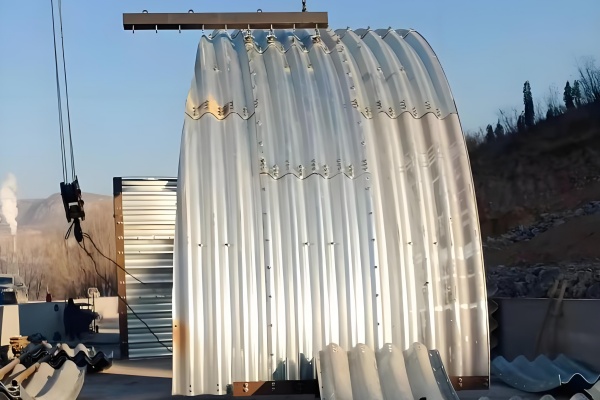
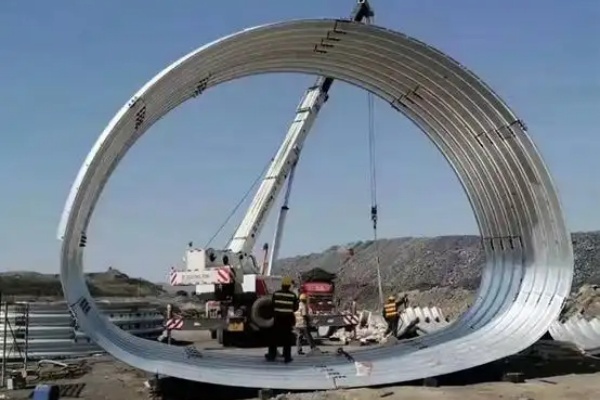
Before installation, check the flatness and elevation of the bottom of the steel corrugated pipe culvert, and determine the position and central axis of the culvert pipe.Using the midpoint of the central axis as the reference, position the first corrugated plate and extend from this point towards both ends to the ends. The axial lap length is 100 mm. The second plate is overlapped (lap portion) on top of the first plate, aligning the connection holes. Apply lubricant to the threads of the bolts, insert them with washers from the inside out into the holes, place washers on the opposite side, screw on nuts, and pre-tighten the nuts with a socket wrench.Assemble sequentially from bottom to top. The circumferential lap width is 150 mm. In the lap portion, the upper plate covers the lower plate. The circumferential connection adopts a stepped pattern, meaning the overlapping seams of two upper plates are staggered. After aligning the connection holes, use bolts coated with lubricant, fit with washers (use convex washer 2 for valleys, flat washer 3 for crests, do not reverse them), insert from the inside out into the holes, and pre-tighten the nuts with a socket wrench. One ring is assembled by lapping four arc-shaped segments.
Sealing and Anti-Corrosion Treatment
After the circular pipe culvert is laid in place or the culvert is assembled, sealing and anti-corrosion treatment shall be carried out on-site before backfilling. Seal the overlapping joints of the culvert structural plates, the joints at the ends of the circular pipe, and the gaps at the bolt holes for fastener connections with weather-resistant sealant. This can be injected or applied using a specialized glue gun, and after curing, it enhances the overall sealing of the circular pipe culvert or the culvert.
Coating Damage Repair
Carefully inspect the inner and outer surfaces of the culvert. Repair any damage points to the anti-corrosion coating by cleaning, derusting, and applying different remedial treatments such as zinc spraying, epoxy resin spraying, or asphalt painting to prevent reducing the durability and anti-corrosion capability of the entire culvert.
Subgrade Construction Requirements for Steel Corrugated Pipe Culverts
The construction process for steel corrugated pipe culverts is: Site Clearing → Foundation Pit Excavation → Setting Out → Base Leveling → Foundation Pit Elevation Measurement → Foundation Bearing Capacity Test → Casting Base Concrete → Installing Round Pipe → Pipe Transport → Concrete Mixing → Concrete Transport → Pouring Concrete Outside Pipe Wall → Supervision Inspection → Sealing Joint → Entrance Paving → Abutment Back Backfilling → Acceptance Layered Compaction → Supervision Inspection.
Construction Quality Management of Steel Corrugated Pipe Culverts
The construction of expressway culverts is significantly influenced and constrained by hydrogeological conditions, such as soil type, natural foundation conditions, water distribution, and local climate. These factors determine the type, size, function, and quality requirements of the culvert.
Technical factors have a crucial impact on the quality of highway culvert construction. The maturity, applicability, and advancement of the construction technology directly determine the construction quality of the culvert.
Material quality is the prerequisite for ensuring construction quality. Its quality and performance are critical to the quality of the culvert. Strict quality acceptance of steel corrugated pipe materials should be carried out during procurement and construction phases. Additionally, the quality of backfill soil should be determined by geotechnical tests to ascertain soil properties and indices, selecting appropriate fill materials for backfilling.
Human factors are the most subjective and prone to sudden changes. Before culvert construction, select operators with strong professional skills and provide thorough technical briefings to them. During construction, technical personnel must supervise and inspect the culvert construction quality throughout the day to ensure quality control over the entire construction process. For instance, if the welding of the steel corrugated pipe is inaccurate or not airtight, it will create hidden dangers for the culvert quality.
Construction Quality Management Measures
Raw materials are the fundamental guarantee of project quality, and their importance is self-evident. Only by controlling raw material quality at the source can the achievement of overall project goals be ensured. Therefore, the thickness, height, and strength of steel corrugated pipe materials should meet the design and specification standards. At the same time, the material quality acceptance of steel corrugated pipes should be strengthened. Improving the quality level of the main structure will have a decisive role in the overall quality of the culvert and also ensure the safety of construction personnel.
Establishing a professional and rigorous quality management system is an effective guarantee for strengthening construction quality management, facilitating the comprehensive execution of project supervision, and enhancing the implementation of whole-process quality management. Therefore, it is crucial to leverage the horizontal and vertical supervision roles of various levels and departments within the construction unit, implement various management objectives, and achieve coordination between the construction owner, construction unit, and supervision unit. Furthermore, quality supervision methods should be strengthened, taking targeted, goal-oriented, and sequential measures to gradually achieve quality management goals.
Implement technical standards for culvert construction across all construction phases. First, collect and organize the engineering design drawings, standardize construction processes and operational procedures. For special foundations and geological/hydrological conditions, adopt reasonable methods for pre-treatment, ensuring the construction quality of the culvert's main structure through foundation bearing capacity testing. Second, during engineering construction, focus on the construction technology, waterproofing performance, and deformation stress analysis of the steel corrugated pipe culvert. Simultaneously, strengthen technical aesthetics, emphasizing the combination of practicality and aesthetics to improve engineering efficiency and quality level. Finally, strengthen dynamic quality inspection during the process. Precisely locate the culvert's position and elevation. Strictly inspect the thickness and strength of the external concrete of the steel corrugated pipe. Ensure a certain fill height between the culvert and the pavement. During the filling process, strictly implement symmetrical construction to prevent the generation of concentrated stresses that could affect the culvert's quality.
Culvert construction is a complex task. During the preparation phase, terrain conditions must be investigated. Before starting culvert work, the position, length, inlet/outlet elevation, and connection to the irrigation/drainage system should be verified based on the design documents combined with the actual terrain and geological conditions on site. Due to its inherent advantages, the steel corrugated pipe culvert has become a primary design choice for expressway culverts. For the quality of steel corrugated pipe culverts, control must be strengthened in three aspects: design, construction, and quality management. The adoption of steel corrugated pipe culverts solved the quality problems of culverts on the Longyong Expressway, and the research on their design, construction, and quality management provides a practical basis for their subsequent application.



 Products