Spiral Ribbed Corrugated Steel Culverts: Field Performance, Cost Savings, and Installation Guide
Spiral Ribbed Corrugated Steel Culverts: Field Performance, Cost Savings, and Installation Guide
Meta Description: Discover why spiral ribbed corrugated steel culverts outperform concrete bridges in permafrost, soft soil, and remote sites. Real project case, technical specs, corrosion protection, and step-by-step installation best practices.
Introduction
In 2022, a highway maintenance team in northern British Columbia faced a recurring problem. A small concrete box culvert on the Alaska Highway had heaved twice during spring thaw, cracking the pavement and creating a dangerous bump. The repair budget was limited, and the construction window was only six weeks.
They chose a 2.5 m diameter spiral ribbed corrugated steel pipe culvert. Assembly took three days. Backfill was completed in another four. Two winters later, no settlement, no cracking, and the ride is smooth.
This is not an isolated success. Across permafrost zones, high�altitude plateaus, and soft�soil coastal plains, spiral ribbed corrugated steel culverts are becoming the standard for drainage crossings. This article explains why, backed by real project data, and provides a complete technical guide for engineers and contractors.
1. Why Spiral Ribbed Corrugated Steel? A Comparison
The table below compares three common short�span crossing solutions for the same 3 m clear span and 2 m cover height.
| Feature |
Spiral Ribbed Steel Culvert |
Reinforced Concrete Box Culvert |
Short�Span Concrete Bridge |
| Foundation requirement |
Low (bearing capacity ≥ 50 kPa) |
Medium (≥ 100 kPa) |
High (deep footings or piles) |
| Tolerance to differential settlement |
Excellent (flexible ring) |
Poor (rigid – cracks) |
Poor (abutment rotation) |
| Installation time (crew of 4) |
2–4 days |
10–14 days (form, pour, cure) |
20–30 days (piers, deck, rail) |
| Material transport (remote site) |
Light – flat packed |
Heavy – ready�mix plant needed |
Very heavy – rebar, cement, forms |
| Cold climate / freeze�thaw performance |
No frost heave damage |
Spalling, ice jacking |
Bearing movement issues |
| Initial cost (installed, USD per meter) |
600–600–900 |
1,200–1,200–1,800 |
2,500–2,500–4,000 |
| Maintenance frequency |
Low (inspect coating every 15–20 years) |
Medium (crack sealing, joint repair) |
High (joints, bearings, railing) |
Key takeaway: For remote, cold, or poor�soil sites, spiral ribbed steel culverts offer lower upfront cost, faster construction, and longer trouble�free life.
2. Real�World Case Study: Qinghai�Tibet Plateau (4,500 m elevation)
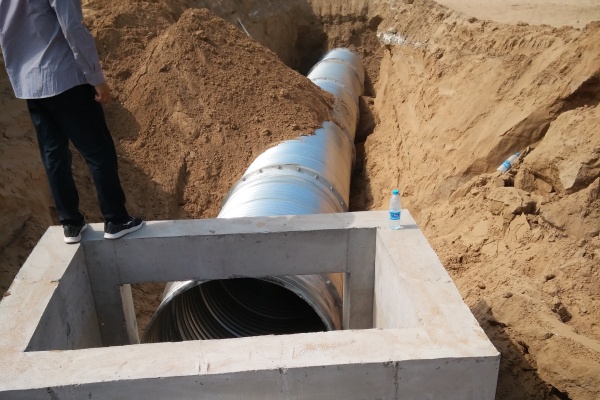
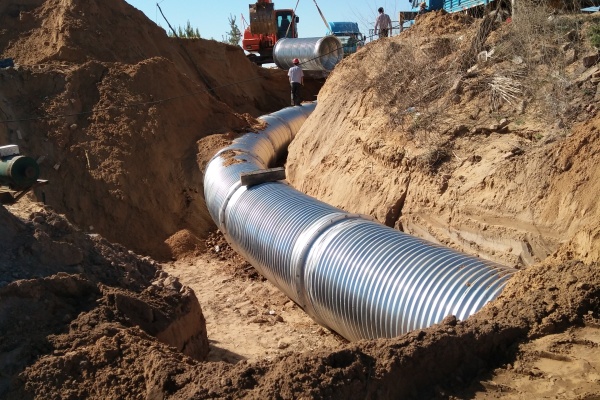
A provincial road crossing a seasonally frozen stream required three 2.0 m diameter culverts. The site had: Permafrost active layer depth: 1.2 m Short summer construction season (July–September) No local aggregate suitable for concrete Oxygen level only 60% of sea level – worker efficiency reduced Concrete option was rejected because of: High cement transport cost (1,200 km one way) Need for heated curing Risk of frost heave within 2 years A light excavator prepared the trench bottom. Three workers assembled each 6 m section in 4 hours using hand torque wrenches. No concrete footing – only 200 mm of compacted gravel bedding. Backfill was local sandy gravel (no cement required).
Result: Installed in 5 days per culvert. After 4 years of freeze�thaw cycles, no settlement, no visible corrosion, and no maintenance. Cost was 45% lower than the concrete alternative.
3. Technical Specifications: What You Need to Specify
When ordering a spiral ribbed corrugated steel culvert, include these minimum requirements: 3.1 Geometry and Steel Shape: Circular (also arch or pipe�arch available) Diameter range: 0.6 m to 8.0 m Corrugation pattern: 68 × 13 mm or 125 × 25 mm (pitch × depth) Steel thickness: 2.5 mm to 6.0 mm (per AASHTO LRFD or equivalent) Yield strength: ≥ 230 MPa (ASTM A796 Grade 33 or higher)
3.2 Joints and Fasteners Flange type: Angle steel + flat steel, fully welded to corrugated pipe Bolts: Hot�dip galvanized, strength grade 8.8 or higher Torque requirement: As specified by manufacturer (typically 150–250 N·m for M20 bolts) Washers: Flat + spring washers to prevent loosening
3.3 Corrosion Protection Base coating: Hot�dip galvanized per ASTM A123 or ISO 1461 Minimum average zinc thickness: 84 μm (600 g/m² total both sides) Field touch�up: Zinc�rich paint on cut edges, weld seams, and any damaged areas Bituminous end coating: Apply at site to the last 300 mm of each end before backfill (two coats)
3.4 Sealing Gasket material: EPDM rubber ring (preferred) or compressed asbestos�free fiber rope Installation: Clean flange faces, place gasket without stretching, torque bolts evenly
4. Frequently Asked Questions (FAQ)
Q1: Can spiral ribbed steel culverts be used under railway loads? A: Yes, with thicker steel (≥ 4 mm) and increased cover height (typically ≥ 1.2 m). Design must follow AREMA or similar railway standards. The ring compression design is well suited for dynamic loads.
Q2: What is the maximum cover height? A: For standard sections, up to 15 m of fill is possible with proper gauge selection. For example, a 3 m diameter pipe with 5 mm steel can handle 10 m cover under highway loading. Consult manufacturer tables or AASHTO.
Q3: How long does galvanizing last? A: In neutral soil (pH 5–8, resistivity > 2000 ohm·cm), 84 μm zinc typically provides 50–70 years before first maintenance. In aggressive environments (acidic mine drainage, coastal salt spray), consider polymer coating or increased zinc thickness.
Q4: Can I repair a dent or minor deformation? A: Small dents (≤ 5% of diameter) are generally acceptable – the flexible structure redistributes loads. For larger deformations, use hydraulic jacks and internal bracing to restore roundness before backfilling. Never weld patch plates in the field without corrosion protection.
Q5: Is a concrete footing absolutely necessary? A: No. Granular bedding (gravel or crushed stone) is standard. Concrete footings are only required for very poor soils (bearing capacity < 30 kPa) or for arch shapes without bottom. For most circular pipes, flexible bedding works better because it yields slightly with settlement.
Q6: Do I need a separate safety grate or end treatment? A: For culverts with diameter ≥ 1.2 m and accessible to people or livestock, check local regulations. Many agencies require a safety grate at the inlet or a headwall to prevent entry. Both can be fabricated from galvanized steel and bolted to the end flange.
5. Quality Control and Long�Term Monitoring
After installation, perform these checks: Bolt torque audit: Check 10% of bolts (random) with a calibrated torque wrench. Water tightness: For submerged conditions, partially fill the culvert before backfill and look for leaks at joints. Coating inspection: Photograph any zinc damage for touch�up record. Invert elevation survey: Confirm final grade matches design within ±15 mm. Recommended inspection interval: Every 5 years for the first 20 years, then every 3 years. Use CCTV for internal inspection. Look for: Rust staining at joints Loss of zinc (white rust is normal; red rust needs repair) Joint gap opening (should be < 5 mm)
6. Conclusion
Spiral ribbed corrugated steel culverts are not a niche product. They are a primary solution for engineers facing difficult ground conditions, remote logistics, or tight budgets. The combination of factory�controlled galvanizing, simple bolted assembly, and structural flexibility delivers reliable performance where concrete and rigid bridges fail.



 Products