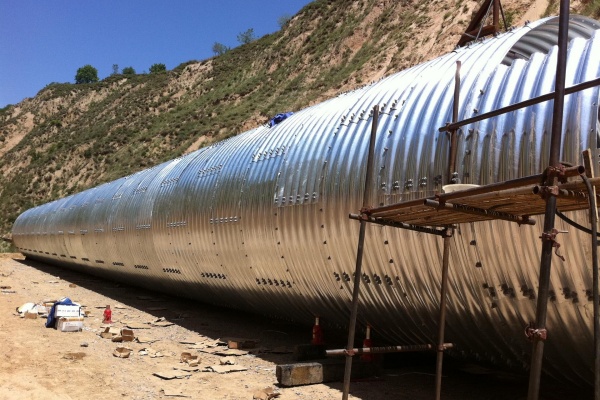
Corrugated Steel Pipe Culverts: An Innovative Solution for Bridges and Culverts
Corrugated steel pipe (CSP) or corrugated structural plate (CSP) bridges and culverts are a new type of structure where steel corrugated pipes or corrugated structural plates replace reinforced concrete pipes or supporting structures in culverts and small bridges. Corrugated steel culverts feature advantages such as convenient construction, strong adaptability, long service life, and high cost-effectiveness.
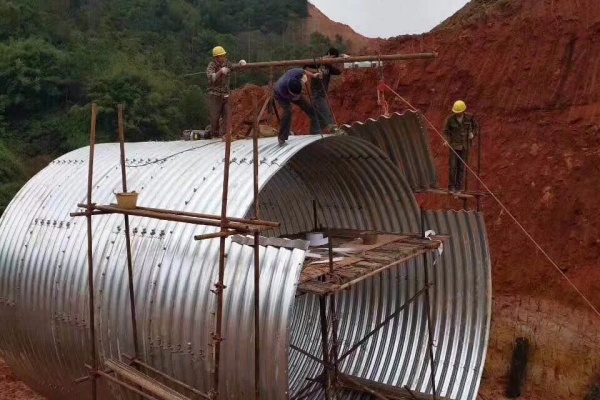
Their construction can employ the embankment method or the counter-trench backfilling method, with the latter generally being more commonly used. The construction process for the counter-trench backfilling method is as follows: Pre-construction preparation → Construction staking → Excavation of trench → Leveling the trench bottom → Testing compactness, moisture content, etc. → Level surveying → Layered compaction and backfilling of the foundation in the trench bottom → Testing compaction degree, moisture content, foundation camber, etc. → Level surveying → Leveling the trench bottom and construction site → Staking for pipe installation → Assembling the pipe body → Testing water tightness and bottom longitudinal slope → Inspecting and remedying the anti-corrosion coating → Positioning the bridge/culvert → Layered compaction and backfilling on both sides → Testing compaction degree, moisture content, etc. → Layered compaction and backfilling over the pipe crown → Testing compaction degree, moisture content, etc. → Inlet and outlet treatment.
Excavate the trench according to the location marked on the construction drawings. The trench width should be greater than twice the diameter of the corrugated metal culvert (ensuring a minimum unilateral clearance outside the pipe of not less than 1.5m) to meet construction space requirements, facilitate the assembly of the corrugated pipe culverts, and also benefit the backfilling and compaction around the pipe. The excavation depth of the trench is based on the designed burial depth plus an additional foundation depth of 30cm~80cm (depending on geological conditions).
As the corrugated steel pipe for semi-circular arch bridges/culverts is installed on reinforced concrete supports on both sides, the location and dimensional requirements for trench excavation should strictly follow the construction drawings, including the overall excavation requirements considering the concrete or reinforced concrete supports, to ensure sufficient foundation for the supports and construction space. If the bridge/culvert location is in an original mountain gully or riverbed, only the foundation pits for the reinforced concrete supports need to be excavated.
2.1.1 The foundation for a corrugated steel pipe culvert is generally a flexible foundation but should be capable of providing uniform bearing capacity along the entire length of the culvert. The settlement of the culvert base and the settlement of the subgrade on both sides are consistent; therefore, during culvert construction, no special treatment for the base of the corrugated steel pipe alone is necessary. On sections with poor geological conditions such as soft soil areas, the basic principle is that the treatment for the culvert base should be the same as that for the subgrade. Methods for ground treatment include:
Unscreened sand, crushed stone, gravelly soil, and sandy soil are ideal foundation materials, but stones and other hard objects larger than 10cm must be removed, and the material compacted in layers.
For ordinary foundations with relatively low bearing capacity, a foundation layer of a certain thickness needs to be provided. However, if the original soil in the pipe bottom trench is strictly compacted (achieving a compaction degree of 92% or more of the heavy compaction standard), the corrugated steel pipe can also be installed directly on the ground.
For ordinary foundations with relatively low bearing capacity, a foundation layer of a certain thickness needs to be provided. However, if the original soil in the pipe bottom trench is strictly compacted (achieving a compaction degree of 92% or more of the heavy compaction standard), the corrugated steel pipe can also be installed directly on the ground.
Corrugated steel pipes must not be placed directly on rock or concrete beds, as overly rigid support not only reduces the inherent good flexibility of the pipe wall but also diminishes the bearing capacity of the corrugated metal culvert. Therefore, for rock foundations, a portion of the rock layer should be excavated and replaced with a layer of high-quality soil; a replacement thickness of no less than 30cm is generally appropriate, and it must be carefully compacted. When excavating rock trenches, avoid using high explosives and deep-hole blasting to prevent excessive loosening of the outer rock layers. Weathered rock layers cannot serve as a foundation either; they require replacement with high-quality soil across a width of 3 times the pipe diameter, compacted in layers.
When the corrugated steel pipe is on a soft soil foundation, the soft subgrade needs treatment. The foundation treatment method for the culvert is the same as that for the subgrade of that road section. After treatment, a layer of high-quality gravel cushion course greater than 30cm thick should be laid on the surface.
Due to the special properties of collapsible loess, after trench excavation, the base should be backfilled with no less than 50cm thick rubble concrete (or a 3:7 lime-soil mixture), followed by a surface layer of high-quality gravel cushion course 30-80cm thick.
For riverbeds with perennial water flow, where silt often has very low bearing capacity, riprap placement is generally used for treatment. The riprap thickness is about 1.0~3.0m. After it stabilizes, compact it using compaction machinery, and then lay a gravel cushion course of no less than 30cm. If the riverbed deposit consists of sandy or gravelly material, the corrugated steel pipe can be installed directly after compaction.
During the foundation construction for a corrugated steel pipe culvert, a longitudinal pre-camber of 0.3%~1% should be reserved in the foundation. Corrugated pipe culverts buried in general soil foundations often experience some settlement over time, typically greater in the middle of the pipe than at the ends. Therefore, for corrugated steel pipes installed under embankments, a pre-camber (upward in the middle) must be set in the pipe body. Its magnitude is determined by considering factors such as potential foundation settlement, longitudinal slope of the culvert bottom, and fill height. It is usually 0.3%~1% of the pipe length, with a maximum not exceeding 2%, to ensure the pipe does not develop a mid-span depression or slump.



 Products