

Differences Between Chinese National Standards and European Models, and Key OnSite Control Points
As international infrastructure cooperation deepens, steel corrugated pipe culverts are being used extensively in overseas projects. However, design drawings often present a mix of Chinese national standard (JT/T 791) series designations and proprietary European manufacturer models (e.g., ViaCon, HelCor, etc.). For the onsite construction team, accurately identifying the meaning of each model, understanding the differences in product characteristics under the two standard systems, and adopting appropriate installation measures are essential to ensuring project quality and schedule compliance.
This article is intended as a practical technical reference for project managers and frontline crews. It systematically reviews the core differences between Chinese standard models and European models, and distills three golden rules of onsite control that apply regardless of the standard system adopted.
1. Model System Identification – Understanding Product Nature Through Naming Rules
Chinese National Standard Models – Standardized Series The Chinese standard uses unified product codes with clear structure:
ACSP (Annular Corrugated Steel Pipe): Factoryrolled, onepiece round pipe, suitable for small to medium diameters.
HCSP (Helical Corrugated Steel Pipe): Formed by spirally winding steel strip, with continuous helical corrugations.
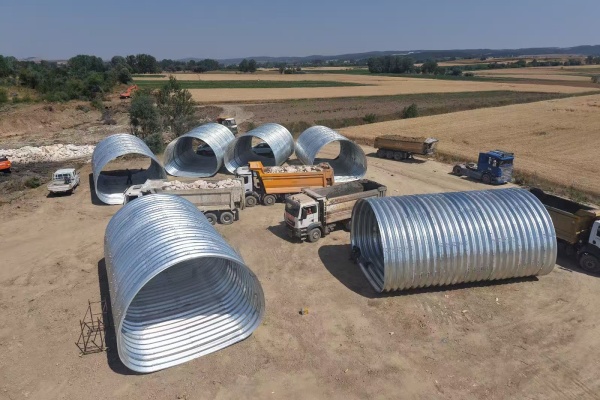
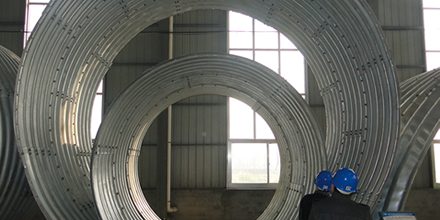
CSPS (Corrugated Steel Plate Structure, assembled type): Composed of individual corrugated steel plates bolted together on site, suitable for large diameters and noncircular crosssections.For example, the designation “CSPS E3000” clearly indicates: assembled structure, corrugation code E (pitch 200 mm, depth 55 mm), and nominal internal diameter 3000 mm. Once such a model is specified on the drawings, the delivered plates – hole spacing, corrugation profile, and thickness – are consistent nationwide, greatly facilitating construction planning.
European Manufacturer Models – PerformanceOriented, Proprietary Designations
There is no mandatory unified model standard in Europe. Common product lines such as “HelCor®” and “ViaPlate®” are proprietary to their manufacturers. Their designations do not directly reveal diameter or corrugation dimensions; instead, one must refer to the corresponding technical manuals and combine them with material grades (e.g., EN 10346), galvanizing class, and design loading (per Eurocode) to determine the actual product specifications.
Onsite note: When facing drawings with European model numbers, do not apply past experience from Chinesestandard projects. Upon delivery, immediately verify the factorysupplied installation drawings, measure bolt hole center distances and edge clearances of every piece, and confirm they match the delivered components before starting assembly.
2. Corrugation Parameters and LoadCarrying Capacity
The pitch and depth of the corrugations directly determine the sectional stiffness of the culvert, and are the primary technical parameters for model selection.
| Corrugation Type | Pitch (mm) | Depth (mm) | Applicable Conditions and Structural Forms |
|---|---|---|---|
| Small wave (Chinese A/B) | 68 – 75 | 13 – 25 | Mostly used for smalldiameter round pipes; fill height generally ≤2 m; easy to handle, requires uniform foundation. |
| Medium wave (Chinese C/D/E) | 125 – 200 | 25 – 55 | Most common for highway culverts; balances stiffness and economy; suitable for moderate fills and standard highway loads. |
| Large wave (Chinese G/H and European large profiles) | 230 – 300 | 64 – 110 | Designed for high fills, heavy traffic, or large spans; deeper and thicker plates offer significantly better resistance to deformation. |
Construction suggestion: During unloading, verify that the delivered corrugation matches the design drawings. If the corrugation is smaller than required while the design fill height is high, or if the profile does not match, stop work immediately and report to the technical supervisor. Never install based on personal judgment.
3. Construction Characteristics: FactoryRound Pipes vs. BoltTogether Plates
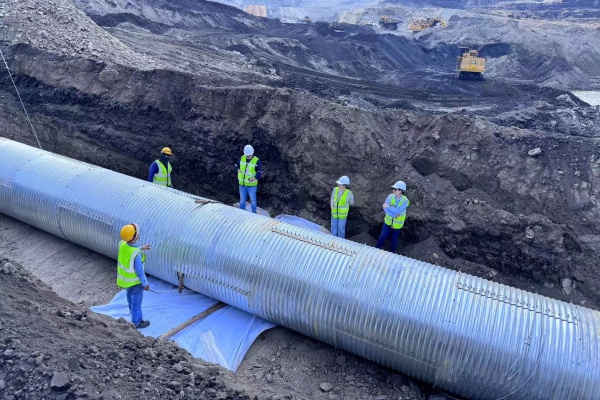
3.1 FactoryRound Pipes (ACSP / HCSP) – Efficient Installation Factoryround pipes arrive as complete circular sections. Installation is straightforward: level the trench bottom, lay a gravel or sand cushion, position the pipe with a crane, align the centerline and elevation, then backfill. The main advantage is high daily production – ideal for long linear projects with rapid progress. Special attention must be paid to foundation treatment; any sharp stones or hard protrusions can cause local stress concentrations in the pipe wall. A compacted layer of graded crushed stone or mediumcoarse sand is recommended as a leveling bed.
3.2 BoltTogether Plates (CSPS / ViaPlatetype) – Precision Control Bolttogether culverts consist of multiple curved plates assembled on site with highstrength bolts. Installation precision directly affects the overall structural behavior. Key control points include:
Firstring positioning: The roundness and verticality of the first ring set the reference for all subsequent rings; deviations must be kept within the allowable tolerances. After completing the first ring, the technical staff shall remeasure and confirm before continuing.
Bolt torque management: All connection bolts must be tightened with a torque wrench to the design torque value – never by “feel.” Overtightening may cause deformation around bolt holes or cracking of the galvanized coating; undertightening reduces joint stiffness.
Joint sealing: Apply sealing gaskets or sealant at the seams as specified on the drawings to prevent water ingress and subsequent corrosion after backfilling.
4. OnSite Quality Verification of the Galvanized Coating
The quality of the galvanized layer is a critical but often overlooked factor that determines the service life of the culvert. The construction team should inspect it immediately upon material arrival.
Chinese standard products: Typically require a doubleside galvanizing mass of not less than 600 g/m². the coating is thicker than specified. A simple visual check can be performed on site: the coating should show a uniform silverygray appearance, without large dark spots, peeling, or exposed bare steel. If the coating appears suspect, it is advisable to apply an additional coaltar epoxy or bituminous coating before backfilling as supplementary protection.
For ordinary dry culverts, qualified Chinese standard galvanizing is fully capable of meeting the design service life.
5. Core Construction Principles – Applicable to Any Standard System
Regardless of the model or standard, the following three fundamental principles are the basis for longterm safety and performance:
Principle 1 – Foundation Bearing Capacity Must Be Verified
The subgrade beneath the culvert must be compacted or replaced to achieve the bearing capacity specified in the design documents. Even the heaviest corrugated pipe installed on a soft foundation will suffer differential settlement, leading to cracking or joint leakage.
Principle 2 – Backfill Must Be Symmetrical, Lifted, and Compacted
Backfill material shall be placed symmetrically on both sides of the pipe and spread in uniform layers, with each loose layer not exceeding 30 cm in thickness. Compaction shall be strictly controlled to the specified density. Never push material from one side only, as this creates excessive lateral thrust that can distort the pipe. During backfilling, continuously monitor the pipe crown and sidewall deformation; if abnormal movement is observed, stop work immediately and investigate the cause.
Principle 3 – Never Mix Plates from Different Standard Systems
Chinese and European corrugation profiles differ in pitch, depth, and bolt hole arrangement. Components from the two systems are not interchangeable and must not be mixed within the same ring or structure. Mixing them will result in misaligned bolt holes, excessive seam gaps, and discontinuous structural behavior. The cost of rework far exceeds the cost of waiting for the correct components.
Closing Remarks
Chinese national standard steel corrugated pipe culverts excel in standardization, supply speed, and installation simplicity, making them ideal for largescale conventional projects. European models, with their refined design, higher corrosion protection levels, and customisation capabilities, offer advantages under special site conditions. For the construction team, a clear understanding of the differences in model designation, corrugation selection, assembly techniques, and corrosion protection – combined with unwavering adherence to the three quality cornerstones (foundation, backfill, and bolt torque) – will ensure that every culvert project is delivered safely and durably.
(This article is based on current standards and field practices. For specific projects, always follow the approved design drawings and applicable local regulations.)