The Superiority of New-Technology Metal Corrugated Pipe Culverts in High-Altitude & Severe-Cold Regions
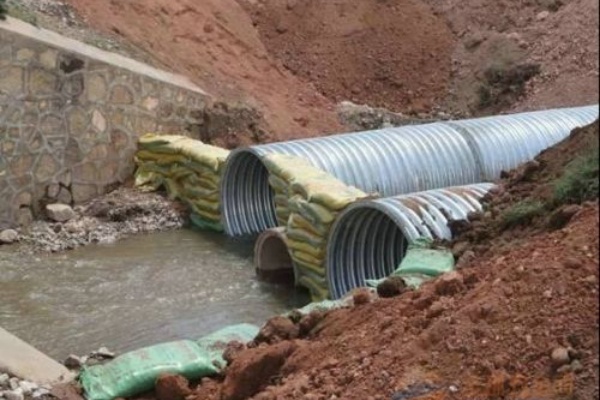
(1) Utilizing standardized design and manufacturing, metal corrugated pipe culverts boast a simple production process and significantly shorter construction periods. Their installation does not require large machinery, primarily relying on assembly (typically completed within one workday for a single culvert). This drastically reduces the exposure time of permafrost, minimizing thaw-related issues. Construction mainly involves preparing the foundation and inlets/outlets, drastically cutting the need for materials like cement, block stone, rubble, gravel, and sand. By replacing reinforced concrete, metal corrugated pipes effectively mitigate the problem of structural damage to concrete culverts in frigid winter conditions.
(2) As a flexible structure, the corrugated pipe culvert excels in compensating for lateral displacement. It leverages steel's high tensile strength and superior deformation capabilities, offering exceptional resistance to deformation and settlement. This makes it particularly suitable for areas with low foundational bearing capacity, such as soft soil, expansive soil, and collapsible loess
(1) Construction Preparation ① Gather all necessary tools: Prepare all the plum blossom wrenches, adjustable wrenches, straight iron bars, hammers, chisels, flat-head screwdrivers, and jack(s). Ensure all required bolts and rubber-asbestos gaskets are on hand. Verify that the length and diameter of each pipe section match the culvert design. Appoint a director to oversee lifting operations and on-site crew activities. Check the foundation for levelness, horizontality, and elevation. Establish the culvert's position, center axis, and midpoint. Lay a gravel cushion on the foundation, employing the inverted trench excavation method with pre-camber.
(2) Connection and Installation Accurately set out the axis for each pipe section. Plan the position of each pipe according to the actual site conditions. Use a combination of manual labor and excavators for hoisting and placement. Begin installation by placing the first pipe section, aligning its center with the foundation's longitudinal centerline. Position the second pipe similarly. When the flanges of two adjacent pipes are 3-5 cm apart, use a small pry bar to align the bolt holes on the flanges. Pry from the far end of the second pipe to shift it longitudinally until the flange gap is about 2 cm. Insert all bolts and hand-tighten the nuts. After all sections are connected, insert asbestos gaskets between adjacent flanges. Once the gaskets are securely in place, symmetrically and manually tighten the bolts until the visual gap between flanges is 2-3 mm. Apply two coats of hot asphalt to both the internal and external pipe walls, ensuring an even, black coating with adequate thickness. Use jacks to adjust the entire culvert assembly, centering it on the designated axis.
After complete assembly, use a torque wrench to tighten bolts from the bottom up, starting from one end. Avoid over-tightening; torque should generally be between 150-300 kN·m. Replace any bolts requiring torque exceeding 300 kN·m. Conduct a final check of dimensions and shape, and recoat any damaged asphalt. Deformation is within allowable limits.
Compared to traditional reinforced concrete pipe or box culverts, the application of new-technology metal corrugated pipe culverts saves significant amounts of stone and cement, benefiting environmental protection. The construction period can be substantially shortened, accelerating project timelines. This embodies significant economic benefits through earlier operational availability, especially crucial in high-altitude and severe-cold regions where the effective construction window is limited to just 5-6 months per year. Therefore, metal corrugated pipe culverts demonstrate distinct advantages. Currently in the promotion and application phase, their simple construction process, wide applicability (particularly in high-altitude and severe-cold areas), and structural safety predict significant development potential, especially in Western China.



 Products