Research on Key Construction Technologies of Corrugated Steel Culverts in Collapsible Loess Areas
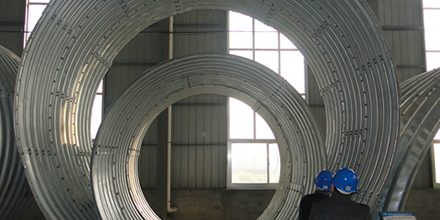
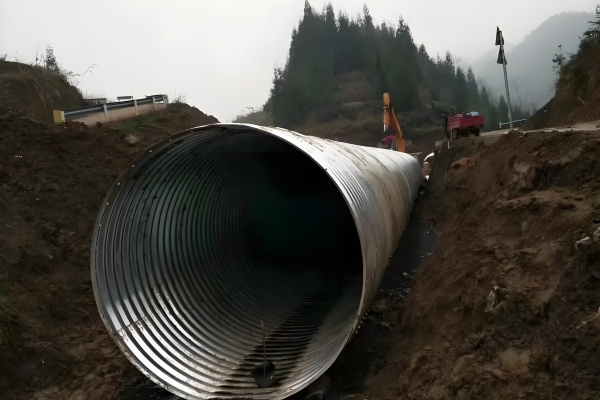
Corrugated steel culverts , also known as corrugated metal culverts , serve as critical drainage solutions. They offer exceptional advantages such as high deformation adaptability, seismic resistance, rapid installation, environmental sustainability, cost-effectiveness, and adaptability to complex terrains, significant settlement, deformation, and varying fill heights. These features make them ideal for steep slopes, high embankments, and challenging engineering environments.
This project involves the main drainage system, The system comprises two Φ2.0m corrugated steel culverts. The culvert originates at the outlet of an existing 1-4.0m reinforced concrete box culvert on the northern slope of the railway’s southwestern section, starting with an inlet drop structure at an elevation of +890.26m. It extends northward for 607.84m to a rainwater collection pool in the riverbed, terminating at an outlet elevation of +798.00m. Along the alignment, the design includes 3 inspection chambers, 1 energy dissipation pool, 2 horizontal bends, and 8 vertical bends (SD1–SD8).
(1) Unstable Rockfall Hazards The exposed bedrock slopes primarily consist of sandstone and mudstone from the Triassic Middle (T₂er) Formation. These alternating sandstone-mudstone layers exhibit pronounced differential weathering, with well-developed joints and fractures. Differential erosion has formed 2–3 tiers of sandstone cliffs, beneath which concave rock cavities are present. These cavities contribute to unstable rock masses prone to collapse. Rockfall debris (3–5m in diameter, up to 8m) is observed along slopes and the gully floor.
(2) Collapsible Loess The upper slopes are covered with Quaternary Upper Pleistocene new loess, exhibiting collapsibility. The collapse coefficient (δs) ranges from 0.015 to 0.042, classifying the site as Grade II (moderate) self-weight collapsible loess.
(3) Expansive Rock Triassic Middle Series mudstone, identified through detailed surveys, exhibits expansive properties (free swelling rate: 30%, montmorillonite content: 19.27%, cation exchange capacity: 325.05 mmol/kg).
1. Earthwork Excavation Mechanical excavation is employed for bulk earth removal, with a 20–30 cm layer reserved at the trench base for manual leveling. Corrugated steel culverts (Φ2000mm) require a foundation bearing capacity ≥200 kPa. Corrugated metal culverts (Φ800mm) require a foundation bearing capacity ≥180 kPa. If substandard soil conditions (bearing capacity < design requirements) are encountered, notify engineers and supervisors immediately for compaction or reinforcement measures. Excavation proceeds from deeper to shallower sections to facilitate drainage. Prevent surface water ingress to avoid trench erosion or collapse. Ensure the trench base remains unsoaked or unfrozen. If local disturbance or waterlogging occurs, backfill with gravel or 3:7 lime-soil mixture.
2. Rock Excavation After overburden removal, bedrock is exposed. Due to nearby residential buildings and existing Phase II structures, blasting is prohibited. Use excavator-mounted rock breakers for excavation. Upon reaching design elevation: Remove dust and loose debris. Clean the surface with high-pressure water jets. Eliminate standing water post-cleaning.
Corrugated steel culverts embedded in loess-filled foundations often experience mid-span settlement exceeding that at the ends. To mitigate this: Pre-camber is applied to culverts under embankments (not required for concrete foundations). Pre-camber magnitude (typically 0.2%–1% of culvert length, max ≤2%) accounts for potential subsidence, longitudinal slope, and fill height.



 Products