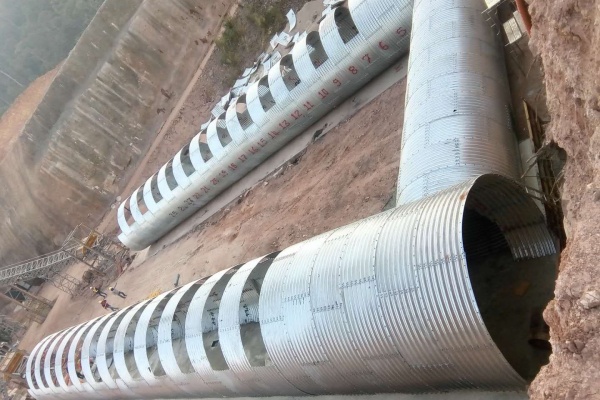
This is the first application of corrugated steel pipe culvert technology in China’s civil aviation engineering sector.
Civil Aviation First! The “Hidden Dragon” Beneath the Runway: How Tengchong Airport Solved a World-Class Challenge with Corrugated Steel Pipe Culverts
Three meters beneath the runway of Tengchong Airport in Yunnan Province, a 666.98�meter�long, 3�meter�diameter corrugated steel pipe culvert has been operating quietly. It is invisible to the eye, yet it shoulders two seemingly contradictory missions: ensuring the absolute safety of aircraft takeoffs and landings, while also guaranteeing irrigation water for farmland on both sides of the runway.
This is the first application of corrugated steel pipe culvert technology in China’s civil aviation engineering sector. Its successful implementation not only saved Tengchong Airport RMB 3.3456 million in investment and shortened the construction schedule by six months, but also set a new benchmark for drainage engineering in high�fill areas within the aviation industry.
An “Impossible Mission” on an 83.6�Meter High Fill
Tengchong Airport is a classic “tabletop” airport. The southern end of its runway sits on an 83.6�meter fill, and the northern end on a 43�meter fill – meaning the entire runway is effectively “perched” on a man�made embankment.
The initial plan called for a single�cell rectangular concrete box culvert, 654.4 meters in total length, crossing beneath the new runway. But the project team soon encountered a critical problem: the area was riddled with underground boulders and stalactite�like rock formations, making precast pile driving extremely difficult. Worse still, the original construction schedule would take eight months – spanning two rainy seasons in Tengchong – which posed enormous risks to both the quality and timeline of the earth�fill work.
With rapid growth in air traffic, the original 2,350�meter runway could no longer accommodate mainstream domestic aircraft such as the B737�800 and A321, making a runway extension imperative. However, the extension involved not only high�fill construction but also the need to maintain irrigation water for hundreds of hectares of farmland downstream.
A Bold Breakthrough: Crossing Over from Highway to Aviation
Faced with this dilemma, the Tengchong Airport construction team did not shy away. After extensive research, they reviewed case studies of box culverts in highway, railway, and major municipal projects, and discovered a solution never before attempted in civil aviation – corrugated steel pipe culvert technology.
This technology was already well�established in highway engineering. With its unique corrugated plate structure and flexible characteristics, corrugated steel pipe culverts have demonstrated significant advantages in high�altitude permafrost zones, soft soil foundations, and deep fill areas. A single section of corrugated pipe weighs far less than a concrete culvert and can be installed manually with light equipment, eliminating the need for heavy cranes. More importantly, the flexible structure effectively accommodates foundation deformation, preventing the cracking and damage caused by differential settlement that often plagues rigid concrete culverts.
But the safety requirements for airport runways are exceptionally stringent: “building a 3�meter�diameter opening through a high�fill foundation, while ensuring that the runway pavement withstands the impact of nearly 100 tonnes per aircraft takeoff and landing, year after year, without even millimetre�level differential deformation.” Transplanting this technology from highways to airport runways demanded both courage and rigorous validation. Ultimately, the Tengchong team made the decisive choice to apply corrugated steel plate assembly technology to this civil aviation runway project.
The Hard Numbers Behind the Success
The technical specifications of this corrugated steel pipe culvert are impressive: Total length: 666.98 meters; internal diameter: 3 meters; drainage gradient: 0.65%; design flow capacity: 22 cubic metres per second.
Pipe body made of Q355B steel plate, assembled from three corrugated panels, connected with M20 class 10.9 high�strength bolts.
Wall thickness: 10 mm under the runway pavements and 9 mm in slope�stabilisation zones.
The inner lower third of the pipe is lined with a composite cement�mortar coating for added durability.
Compared with the concrete alternative, the corrugated steel pipe offers comprehensive benefits. In projects such as the Baise Expressway, it has proven to deliver better quality assurance, significantly shorter construction periods, notably lower material and labour costs, higher strength, superior ductility, and greater deformation capacity. For a 2�metre�diameter pipe, construction costs are only about 80% of those for concrete pipe; for a 6�metre pipe, the cost drops to 70%, while construction time is cut by 50%.
The results at Tengchong Airport were equally remarkable: RMB 3.3456 million in cost savings and six months of schedule reduction, successfully avoiding the risk of construction spanning two rainy seasons.
From “First Attempt” to “Benchmark”
On 18 April 2023, the corrugated steel pipe culvert at Tengchong Airport successfully passed its water�flow test and was officially put into operation. With the joint efforts of all parties involved, the one�time acceptance rate for every construction procedure reached 100%.
This was more than a simple substitution of materials – it was a pioneering exploration of drainage engineering in China’s civil�aviation construction sector. It provides a replicable and scalable practical model for future airport projects built on high fills or in complex geological conditions.
In fact, Tengchong Airport has a history of innovation: in 2013, China’s first home�grown aircraft runway arresting system was installed there; in 2018, a viaduct was built over a nearly 100�metre high fill; and in 2020, the integrated collaborative operations of the western Yunnan airport cluster were officially launched. This corrugated�pipe project continues that tradition of bold thinking.
CThe Hidden Guardian Beneath the Ground.
Today, when you land at Tengchong Airport, you will not see the 3�metre corrugated steel pipe culvert beneath the runway. But it is there, silently fulfilling a dual mission: aviation safety on one side, and the livelihoods of local farmers on the other.
As many transport�engineering observers note, these “hidden dragons” buried under our roads and runways are protecting our travel safety with outstanding performance. The success of corrugated steel pipe culverts at Tengchong Airport proves that in infrastructure construction, daring to innovate and rigorous scientific evaluation can often deliver solutions far superior to traditional approaches.
So the next time you drive or fly over a high�fill section, spare a thought for what lies beneath – there might just be a corrugated steel pipe culvert, like an underground dragon, quietly carrying the double weight of safety and development.



 Products