Corrugated Steel Culvert Applications in Russia: A Key Technology for Arctic Development and Infrastructure Modernization
Across Russia's vast and topographically diverse terrain, corrugated steel culvert technology is quietly forming the backbone of the nation's infrastructure.
From reinforcement projects along the Trans-Siberian Railway to drainage systems within Arctic resource development zones, corrugated steel culverts are playing an increasingly vital role in Russian infrastructure construction. As Russia intensifies development efforts in the Far East and Arctic regions, this solution, prized for its exceptional frost resistance and rapid installation advantages, is garnering unprecedented attention.
In June 2025, industry experts will convene at the SteelStructures exhibition in Moscow to showcase the latest innovations in corrugated steel structures, pushing the boundaries of this critical material's application in harsh environments.
Russia's infrastructure development landscape is undergoing significant transformation. State-led Arctic strategies and Siberian resource exploitation projects are generating massive demand for high-performance, extreme-climate resistant drainage and passage structures.
Corrugated steel culverts, due to their superior engineering properties, have become the ideal choice for these projects. Compared to traditional concrete structures, corrugated metal culverts offer distinct advantages: 30-60% lighter weight, installation speeds increased by over 50%, coupled with excellent foundation adaptability and resistance to frost heave.
Across Russia's immense territory, climatic and geological conditions vary dramatically. The permafrost within the Arctic Circle, swampy wetlands of Siberia, and seasonal freeze-thaw cycles in southern regions all pose unique challenges to subterranean structures. The flexible nature and predictable performance of corrugated steel culverts make them the preferred solution for engineers tackling these challenges.
Transportation network modernization and construction in resource-rich zones are central to the Russian government's current infrastructure investment plans. Many of these projects are located in remote and environmentally sensitive areas, demanding fast-track construction and minimal ecological impact – core strengths inherent to corrugated steel culvert systems.
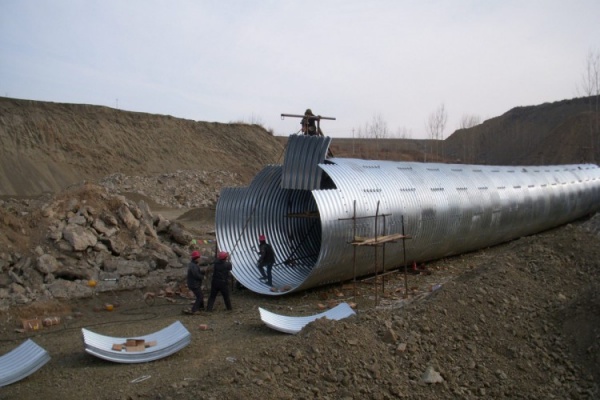
Arctic Resource Development Projects.Within Russia's Arctic development strategy, corrugated steel culvert technology addresses the fundamental challenges of infrastructure construction in permafrost zones. Culverts featuring specialized stiffening rib designs and extra-thick zinc coatings (up to 600g/m²) are employed to withstand extreme temperatures of -50°C and frost heave forces, ensuring reliability for access routes to oil/gas fields and settlement drainage.
Trans-Siberian Railway Reinforcement. As Russia's vital transportation artery, maintaining the Trans-Siberian Railway is paramount. Corrugated steel culverts are widely used for subgrade drainage systems and as replacements for small bridges. Their rapid installation significantly minimizes disruption to railway operations. Field measurements confirm that corrugated metal culvert structures can achieve a service life exceeding 50 years under heavy-haul railway conditions.
In underground utility upgrade projects in major cities like Moscow and St. Petersburg, corrugated steel culverts leverage their variable diameters (customizable from 1-6 meters) and flexible installation capabilities to enhance drainage capacity within confined spaces. Their smooth interior surface (hydraulic friction coefficient of only 0.012-0.024) significantly boosts stormwater discharge efficiency.
Technically, Russian projects primarily adhere to the ASTM A964 standard, while incorporating localized modifications based on national GOST specifications. This dual-standard system ensures structures meet international benchmarks for material properties, geometric dimensions, and sectional performance, while also addressing local environmental adaptability requirements.
Russia's corrugated steel culvert industry is undergoing significant manufacturing upgrades. Severstal, one of the nation's top four steel giants, has made strategic moves notably enhancing domestic supply capabilities for high-grade structural steel.In early 2024, Severstal completed the acquisition of Ventall Steel Solutions and invested over 1 billion rubles to revamp its Cherepovets production base. Following equipment upgrades in 2025, this facility will be rebranded as Severstal Steel Structures, focusing on producing circular metal structures and heavy welded I-beams – essential components for large-diameter corrugated metal culverts.
According to Severstal's expansion plan, its total structural steel capacity is set to reach 126,000 tonnes/year by 2025. This comprises 48,000 tonnes from upgraded existing lines, 48,000 tonnes contributed by acquired entities, and the remaining 30,000 tonnes from the transformed Cherepovets site. Regarding material technology, corrugated steel culverts in the Russian market predominantly use Q235 or higher strength grade steel, with hot-dip galvanizing as the primary surface treatment. High-end products utilize aluminium-zinc alloy (Galvalume) coating technology, extending structure lifespan by 2-3 times in highly corrosive environments. The latest composite coating systems (zinc + polymer coating) have shown significant promise in Arctic test sections and are expected to become standard for next-generation corrugated metal culverts.
As the flagship industry event for Russia's steel construction sector, the Moscow SteelStructures Exhibition will be held at the Moscow International Exhibition Centre from June 3-5, 2025. Co-organized by the Steel Building Development Association and the Russian Federation of Metal Product Suppliers, the previous edition attracted 245 exhibitors from China, Indonesia, India, Germany, and others, covering 13,000 sqm of exhibition space with over 8,560 professional attendees.
The 2025 exhibition is anticipated to highlight three key innovation directions: Polar-Specific Structural Systems: Large-diameter, ultra-low-temperature resistant corrugated steel culvert solutions tailored for Arctic development.
Integrated Smart Monitoring: Built-in sensor technology for real-time structural health monitoring. Rapid Assembly Technologies: Lightweight installation systems eliminating the need for heavy equipment, suited for remote area construction constraints.
Russia's corrugated steel culvert market is in a rapid growth phase. Industry forecasts predict sustained annual growth exceeding 12% between 2025-2030, driven by Arctic development and Siberian infrastructure upgrades. This growth trajectory stems from multiple converging factors:
Accelerated Import Substitution: Capacity expansions by domestic leaders like Severstal are reducing reliance on key material imports, lowering project costs by 15-20%. Elevated Technical Standards: Russia is developing localized technical specifications based on ASTM standards, increasing reliability requirements for structures in extreme environments. Expanding Application Boundaries: Moving beyond traditional drainage culverts into new areas like small bridges, underground storage facilities, and military protective structures.
However, the industry also faces significant challenges: Validating performance in extreme environments requires more robust field monitoring data and accelerated aging test methods. Ensuring installation quality control remains difficult in remote projects, necessitating simpler, more reliable connection technologies. Optimizing whole-lifecycle costs demands balancing initial investment with long-term maintenance, especially in low-accessibility regions.
Major Russian Corrugated Steel Culvert Producers: Capacity Distribution Forecast (2025)Over the next five years, innovation in materials and coating technologies will be key to overcoming these bottlenecks. The integration of nano-modified coatings, composite-reinforced structures, and smart monitoring systems will propel corrugated steel culverts into more central roles within Russia's infrastructure development.



 Products