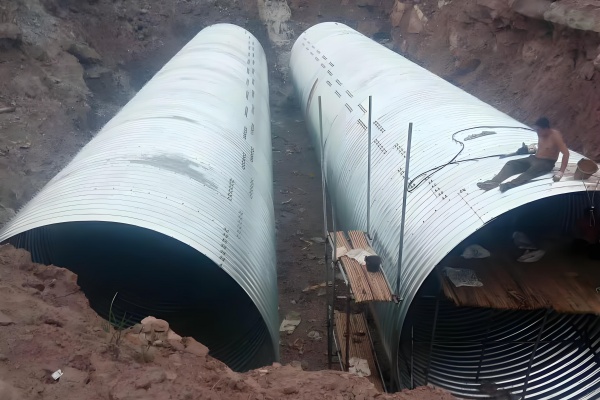
Backfilling Of Corrugated Metal Culverts
1.Conduct on-site sealing and anti-corrosion treatment after corrugated steel pipe culverts are laid in place or after precast bridge/culvert segments are assembled, and before backfilling. Fill gaps at overlapping structural plate joints, pipe end connections, and bolt hole voids of fasteners with weather-resistant sealant using a specialized applicator gun. After curing, this enhances the overall sealing integrity of the pipe culvert or bridge/culvert structure.
2.Carefully inspect the inner and outer surfaces of the bridge/culvert. Clean and remove rust from any damaged points on the anti-corrosion coating. Perform remedial treatment using methods like zinc spraying, epoxy resin spraying, or asphalt coating to prevent a reduction in the overall anti-corrosion durability of the structure.
3.If construction drawings specify other on-site anti-corrosion treatment methods, construct according to those requirements.
Pre-backfilling Check: Backfill promptly after laying the corrugated steel pipe culvert/bridge and completing sealing treatment. However, before backfilling, verify that the culvert/bridge specifications, position, alignment, and gradient meet drawing requirements.
Backfill Material: Backfilling does not require special soil; ordinary soil is acceptable. Within 30cm of the corrugated pipe shell, the fill must not contain stones, concrete chunks, frozen soil lumps, highly plastic clay lumps, or other harmful substances exceeding 8cm in size, to prevent damage to the culvert pipe.
Backfilling Principles:Backfill adhering to the sequence: first the bottom wedge-shaped areas on both sides, then the sides of the pipe body, and finally the top of the pipe body. Ensure work proceeds symmetrically and evenly on both sides of the culvert pipe. Backfilling must involve layered spreading followed by compaction of each layer. The compacted thickness per layer should not exceed 15cm to 25cm. Soil compaction must reach at least 95%. The top compaction should match the subgrade compaction at that location. Backfilling must meet the minimum fill cover thickness requirement over the pipe top. This value is determined based on comprehensive analysis of culvert/bridge size, road grade, and soil conditions. Generally, it should be no less than 0.6m for monolithic pipe culverts and no less than 1.0m for segmentally assembled pipe bridges/culverts. For situations exceeding these limits, ensure culvert/bridge safety by optimizing waveform selection, increasing pipe wall thickness, or adding reinforcement, but the minimum cover must not be less than 0.2m (monolithic pipe) or 0.4m (segmental pipe).
Throughout backfilling, monitor changes in the pipe cross-section shape. The deformation must not exceed 2%. If deformation exceeds the limit, identify the cause and improve backfilling methods or take other effective measures to control shape change within the specified range.
a. Use coarse sand compacted by the "watertight method" with vibratory compactors.
b. Use well-graded natural sand/gravel (water content about 2% higher than optimum). Manually tamp from outside the pipe towards the inside using a wooden rod (15cm x 15cm cross-section). Each impact must achieve 9kg force. The rod's contact point must be tight against the pipe. Tamp thoroughly into every corrugation valley.
Use flowable fly ash or cement slurry grout for backfilling.
Use graded crushed stone with a maximum particle size of 3cm. Then compact obliquely using small mechanical compactors to ensure quality at the pipe bottom. For large-diameter (over 3m) round pipe culverts or arched pipe culverts, backfilling quality at the two bottom sides is especially critical. To facilitate construction and ensure compaction, plain concrete or foam-mixed lightweight soil can be used. Perform normal backfilling of the outer sections after it solidifies. For semi-circular arched bridges/culverts, lacking bottom wedge areas, normal backfilling of outer sections can proceed after the secondary pour solidifies. For multiple adjacent round pipe culverts or continuous-span arch culverts with small spacing due to space constraints, the lower voids between pipes can also be filled with plain concrete or foam-mixed lightweight soil. Normal backfilling of the upper and top sections proceeds after solidification.
a. Longitudinal construction sequence can progress from the middle of the culvert towards both ends. If end walls are built at both ends, work can proceed from the ends towards the middle.
b. Use an 18T roller for compaction beyond 0.6m from the pipe's maximum diameter. Within 0.6m, use small compaction equipment to avoid impact damage from large machinery. Backfill and compact layer by layer. The compacted thickness per layer should be 20cm. Compaction must reach 95% before placing the next layer.
c. Layered compaction on both sides of the pipe body must proceed simultaneously and symmetrically. The height difference of fill on both sides must not exceed 30cm. For multiple parallel bridges/culverts, the middle and outer structures must also follow the simultaneous, symmetrical backfilling principle.
d. During compaction beside the pipe body, compaction equipment should travel parallel to the culvert/bridge axis (length direction). During compaction above the pipe body, compaction equipment should travel perpendicular to the culvert/bridge axis (length direction).
Corrugated steel pipe culverts/bridges can integrate well with existing headwall types. Common headwall forms include flared wing walls, end walls, conical slopes, square ends, straight pipe ends, or straight pipe extensions. Follow design drawings for specific treatment. Generally, corrugated steel pipe culverts/bridges use square-cut ends at both terminals for better structural performance. At culvert inlets/outlets or small bridge ends subject to water flow scour, construct corresponding regulating structures on the channel bed. Also, implement necessary protective measures based on the terrain on both sides. This reduces inlet/outlet scour, prevents loss of material from the corrugated pipe ends and bottom bedding, ensures smooth water flow, and enhances the durability of the corrugated steel culvert/bridge. Construction of the regulating/protection structure foundations should proceed concurrently with the culvert/bridge foundation work.
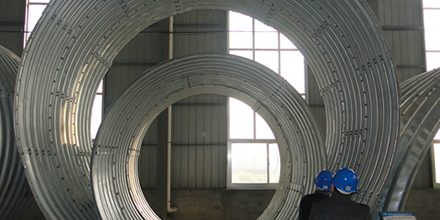


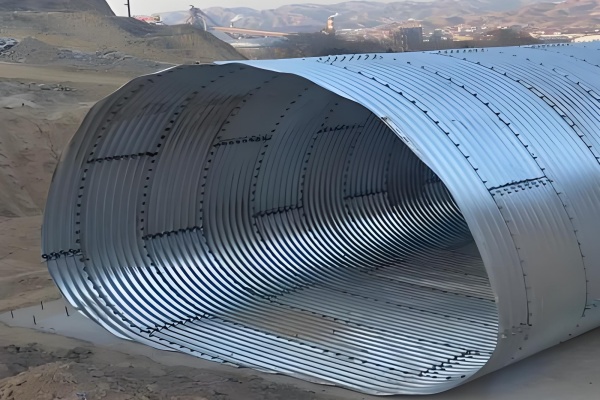

 Products