The Real Cost of Importing Corrugated Steel Culverts: 6 Decision Points That Separate a 50-Year Asset from a 20-Year Liability
The Real Cost of Importing Corrugated Steel Culverts: 6 Decision Points That Separate a 50-Year Asset from a 20-Year Liability
Most importers comparing corrugated steel culverts against concrete start with a simple question: which one is cheaper per meter? That is also where most costly mistakes begin. The installed cost of a galvanized steel culvert can be lower than reinforced concrete, but that gap narrows—or reverses—depending on six variables that are knowable before the order is placed. This article maps those variables, not as a sales pitch for steel, but as a due-diligence framework for buyers who will live with the asset long after the container leaves the port.
1. Specification compliance: “ASTM A760 compliant” is a starting line, not a finish line
When an importer searches ASTM A760 corrugated steel pipe supplier or AASHTO M36 culvert manufacturer, they are asking a binary question: can this pipe pass the engineer’s review? The standard itself is not the hard part. ASTM A760/A760M and AASHTO M36 are technically identical in their core requirements, covering pipe fabricated from metallic-coated steel sheet with zinc, aluminum, or aluminum-zinc alloy coatings. What separates suppliers is documentation depth.
A mill certificate showing “ASTM A760” tells you the base sheet was coated to a standard. It does not tell you the coating weight actually achieved on the finished pipe after forming and punching, nor whether coupling bands, bolts, and gaskets were supplied to the same corrosion class. For importers supplying public infrastructure, the practical filter is whether the supplier can provide a coating mass test report (g/m² or oz/ft²) tied to the specific heat number, not a generic certificate template. Ask for that before the quotation comparison begins. If it cannot be produced, the “compliant” claim is a marketing statement, not a quality record.
2. The cost comparison that matters is not per meter—it is installed plus intervention
Corrugated steel culvert vs concrete cost is one of the highest-volume search phrases in this category, and it is also the one most often answered with a misleading number. The per-meter or per-ton price of steel pipe is easy to quote. The installed cost depends on equipment, bedding, backfill labor, and—critically—the intervention schedule the site conditions will impose. Life-cycle cost analyses comparing buried corrugated steel plate culverts with reinforced concrete have found that steel can be economically superior when the full life cycle is considered under suitable conditions. But the same body of research contains a warning that importers should print and keep: zinc-coated steel pipe has a lower initial installed cost than reinforced concrete pipe, yet in aggressive environments it may require replacement or rehabilitation well before a concrete alternative reaches the end of its design life. One Canadian lifecycle framework places steel culvert rehabilitation at roughly 30 to 40 years after installation, with concrete rehabilitation required later and less frequently.
The takeaway is not that one material always wins. It is that the steel-versus-concrete decision cannot be made on first cost alone. An importer who presents the buyer with a 30-year rehabilitation projection before the order is more credible than one who quotes the lowest number and disappears.
3. Soil chemistry determines whether “galvanized” means 50 years or 15
This is where importers who skip the geotechnical report lose the most money. The service life of a steel culvert is a function of soil pH, resistivity, and abrasion exposure, not a fixed number printed in a brochure. Coating selection must follow those site parameters. For aluminized steel (Type 2) , published corrosion guidelines are explicit: a 50-year maintenance-free service life requires soil, backfill, and drainage water pH within 5.5 to 8.5, and minimum resistivity of 1,500 ohm-cm or greater. Outside that envelope, aluminized pipe is not the right specification, regardless of its coating weight. Aluminum culverts carry additional restrictions: they are generally not recommended where abrasive channel materials are present or where flow velocities frequently exceed 1.5 m/sec.
For standard galvanized pipe, resistivity and pH thresholds are broader but not unlimited. Below roughly pH 5.5 or 1,500 ohm-cm, the corrosion rate accelerates and a heavier zinc coating, a bituminous coating, or a polymer precoated option becomes necessary rather than optional. The practical instruction for an importer is direct: obtain the soil pH and resistivity from the project geotechnical study before the coating is specified. A supplier who quotes a coating without asking for those two numbers is guessing.
4. The installation risk is concentrated in the first 48 hours of backfill
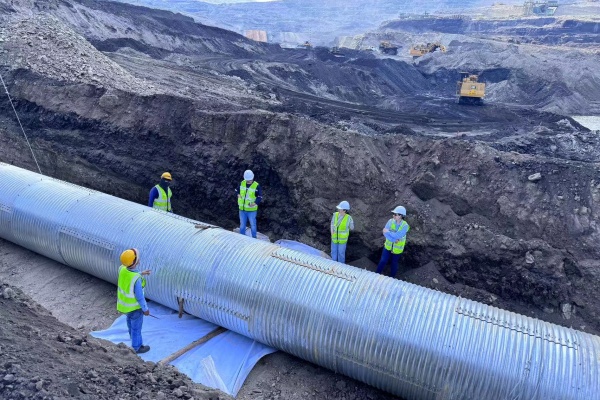
A corrugated steel culvert is a flexible structure. It derives its load-carrying capacity from the interaction between the steel ring and the surrounding soil envelope. That is a strength—but it also means the pipe is only as good as the backfill placed around it.
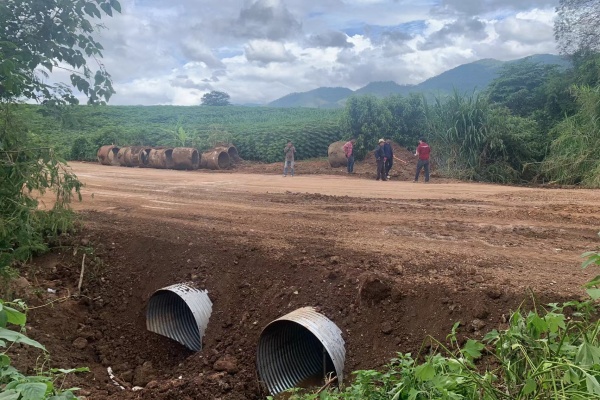
Published installation guidance converges on several non-negotiables. Backfill must be placed in horizontal uniform layers not exceeding 8 inches before compaction, and compacted to no less than 95% Standard Proctor density. The material must be placed uniformly on both sides of the structure; a level difference between the two sides at any transverse section should not exceed 2 feet. Heavy compaction equipment should stay at least 3 feet away from the structure wall to avoid distortion.
The failure mode when these rules are ignored is not subtle. Uneven backfill causes the pipe to deflect, settle, or distort; if curvature flattens excessively, the wall can buckle inward or deflect to the point of reverse curvature. Joints are especially vulnerable: differential movement during backfill can open a joint and create a leak path.
For the importer, this translates into a procurement question: does the supplier provide a written backfill and assembly procedure, and will they review the contractor’s method statement before shipment? A pipe that meets ASTM A760 but arrives without installation guidance shifts the deflection risk entirely onto the buyer.
5. Supplier verification: capacity claims versus auditable evidence
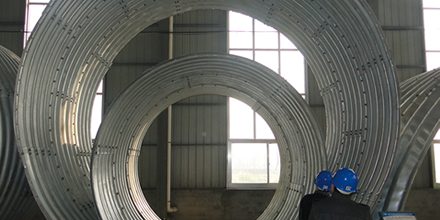
Importers searching corrugated steel culvert factory audit or real factory or trading company culvert are not being paranoid. They are responding to a market where trading intermediaries routinely present themselves as manufacturers. The verification points that matter are specific: does the supplier operate its own corrugation line and coating line, or does it outsource one of them? Can it produce a monthly capacity figure reconciled against recent shipping records? Does it accept third-party inspection at pre-shipment, and will it allow the inspector to witness dimensional checks on corrugation pitch and depth, not just count pieces?
A supplier that welcomes a structured audit—and can walk an inspector through the coating thickness gauge readings at the line—is signaling something different from one that offers only a factory video. For importers placing a first order, the audit is cheaper than a failed container.
6. HS code classification: settle it before the B/L, not at destination
This is the least discussed and most avoidable customs risk in corrugated steel culvert imports. The product sits at the boundary between “steel pipe” and “steel structure,” and customs authorities in different markets have classified it differently. One exporter’s documented experience is instructive: the company used HS 7308.90 (steel structures) consistently, but customs challenged the classification, arguing the product was a metal pipe rather than a structure. The dispute was resolved only after the supplier demonstrated that the culvert is an assembled bolted structure designed to carry bearing loads, functionally closer to a bridge section than to a simple pipe. Meanwhile, HS 7210.41 covers flat-rolled corrugated zinc-coated steel sheet of 600 mm width or more—a classification that fits the raw culvert sheet, not necessarily the finished assembled culvert
The implication for importers is procedural: request the supplier’s proposed HS code and a one-page technical justification before the commercial invoice is issued. If the code will be challenged at destination, the duty and clearance delay cost lands on the importer, not the exporter. A supplier who has never had this conversation is a supplier who has not shipped enough culverts to know where the friction is.
What this means for your next quotation
The six decision points above share a common structure. Each one is knowable before the order, and each one shifts a meaningful cost—replacement, rehabilitation, rework, demurrage, or rejected cargo—onto the party that did not ask the question early enough.
An importer who evaluates a corrugated steel culvert quotation on the basis of price per meter is comparing a number. An importer who evaluates it on the basis of coating test records, soil chemistry compatibility, backfill procedure, auditable capacity, and a defensible HS code is evaluating an asset. The first approach finds the cheapest pipe. The second finds the supplier who will still answer the phone when the inspector arrives at the jobsite.
If you are evaluating a culvert import and want the six checkpoints formatted as a one-page pre-order due-diligence sheet, contact our technical team. We would rather answer these questions before the order than explain them after.



 Products