Why Backfill Determines the Lifespan of Corrugated Steel Culverts
Critical Construction Control Points for Corrugated Steel Culvert Foundation and Backfill
Why Backfill Determines the Lifespan of Corrugated Steel Culverts
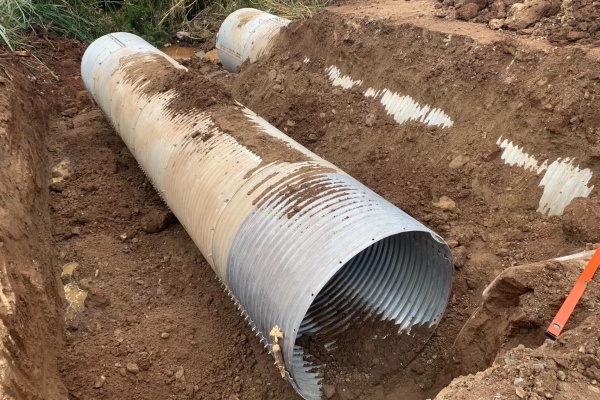
Unlike rigid concrete structures that resist loads by sheer strength, corrugated steel culverts rely on lateral backfill soil to provide confinement. This lateral support keeps the culvert wall deformation within the elastic range. In other words, backfill is not an auxiliary step — it is an integral part of the structural load-bearing system. Poor backfill leads to excessive deformation of the culvert pipe, causing a sharp decline in load capacity and potentially catastrophic failure.
How to Select Foundation and Backfill Materials
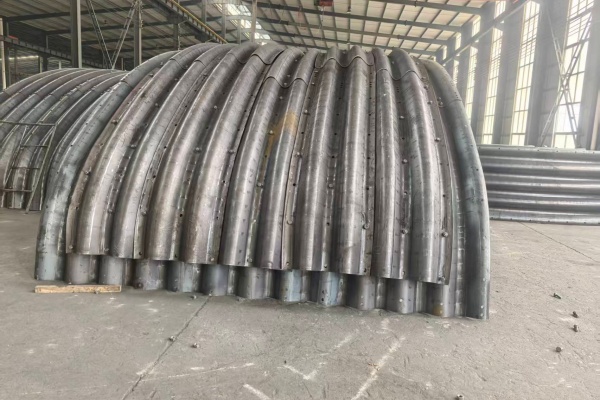
For foundation replacement, sand gravel, crushed stone soil, or sandy soil is recommended. A critical note: within 30 cm outside the pipe wall, the particle size of stone material must not exceed 75 mm. Why 75 mm? The common corrugation depth of steel pipes is about 50–55 mm. Stones larger than 75 mm cannot fit into the corrugation valleys, creating point contact between the pipe wall and backfill. This not only causes stress concentration but also damages the galvanized anti-corrosion coating through abrasion and impact.
Three-Step Compaction Control
Foundation Base
Use a vibratory roller for layered compaction. Each loose layer thickness ≤ 30 cm, achieving compaction degree ≥ 93%. Testing should be completed within 30 minutes after rolling to avoid moisture content changes affecting results.
Wedge Zone at Pipe Bottom
In areas where vibratory equipment cannot reach, use a frog rammer or plate vibratory compactor. Compact at a 45° angle outward from the bottom. Each layer thickness ≤ 15 cm. Use a wooden rod to tamp along the corrugation valleys.
Sidefills and Top Cover
Both sides must be backfilled symmetrically. The height difference between left and right sides should not exceed one layer thickness (30 cm). Otherwise, unilateral thrust will shift the culvert pipe. When the backfill above the pipe is less than 30 cm, only static rolling is allowed. Vibratory compaction may begin only after the cover thickness reaches ≥ 50 cm.
Different Treatments for Frost-Prone and Non-Frost Areas
Frost-Prone Regions
Extend at least 0.5 × culvert diameter (and at least 0.5 m) outward from both sides of the pipe. Extend at least 0.5 m above the pipe crown (or 0.8 m if diameter > 3 m). Replace these zones entirely with sand gravel to isolate frost heave forces.
Non-Frost Regions
Only the lower half of the pipe diameter needs sand gravel backfill. The upper half and the area above the pipe crown can use the same fill material as the roadbed — because there is no frost heave risk, only bottom bearing capacity must be ensured.
Construction Inspection Grading by Culvert Diameter
Diameter ≤ 1600 mm Check key nodes such as foundation, pipe base, wedge zone, and fill thickness. Detailed construction records are not mandatory.
Diameter 1800–3000 mm Inspect each stage of assembly and backfill. Mandatory photo/video documentation is recommended for: Cushion levelness (deviation ≤ 20 mm) Axis deviation of the first pipe section Bolt torque for every three pipe sections Initial pipe wall deformation after wedge zone backfill (not exceeding ±1% of diameter)
Diameter > 3000 mm Assign a dedicated full-time inspector for process surveillance. The inspection effort should be equivalent to conventional bridge construction. All records must be archived.
One-Sentence Reminder for Field Supervisors
Field supervisors and inspectors must be present and confirm critical steps: foundation treatment, wedge zone compaction, and symmetric backfill. Before the backfill thickness exceeds 50 cm above the pipe crown, no heavy machinery is allowed to travel over the culvert top.
Additional Best Practices for Durable Corrugated Steel Culvert Installation
To further enhance the original article and improve its ranking on Google, the following sections expand on the topic with practical advice and engineering insights.
Understanding the Soil-Structure Interaction
Corrugated steel culverts are flexible structures that derive their strength from the surrounding soil. The interaction between the pipe and backfill is a composite system. Proper compaction ensures that the soil develops passive resistance, which counteracts the hoop stresses in the metal wall. Ignoring this principle leads to buckling, excessive vertical deflection (typically limit is 2-3% of diameter), and eventual collapse.
Common Mistakes in Field Practice
Using oversized stones near the pipe – This creates localized bending moments in the corrugation valleys and accelerates corrosion. Asymmetric backfill – Causes the culvert to rotate or translate laterally, misaligning joints and causing leaks. Rushing compaction above the pipe – Vibratory rollers on thin cover can dent the crown and reduce structural capacity. Ignoring moisture content – Dry or saturated soil cannot achieve target compaction density.
Conclusion: Use a 1.5 m diameter corrugated pipe with 6.0 mm wall thickness. It meets the requirement.
Recommended Quality Control Tests
Sand cone or nuclear density gauge – For each lift in critical zones. Deflection measurement – After backfill completion, measure vertical and horizontal diameters. For diameters up to 3 m, deflection should be < 2% of nominal diameter. Bolt torque check – Re-torque bolts after final compaction because soil pressure can loosen connections.
Seasonal Considerations
In cold regions, backfilling should be avoided during freezing temperatures unless using non-frost-susceptible materials. Thawing in spring can cause differential settlement and uneven loading. Install drainage provisions to prevent water ponding near the pipe invert, which can lead to freeze-thaw damage or scouring.
Environmental and Longevity Enhancements
Use polymer-coated or galvanized steel with additional bituminous coating for aggressive environments. Ensure proper inlet/outlet headwalls to prevent erosion of backfill at the ends. Specify geotextile separation layers between different backfill materials to prevent mixing and maintain drainage. This comprehensive guide aligns with AASHTO, ASTM, and international best practices for corrugated steel culvert installation. Following these control points will significantly extend service life and reduce maintenance costs.



 Products